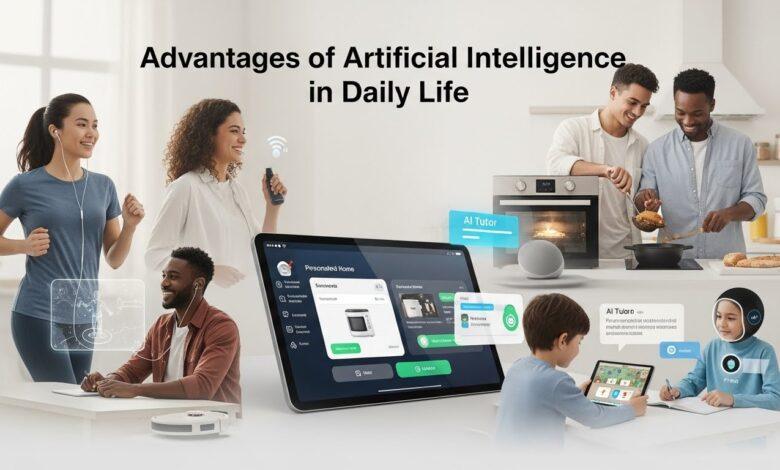
Artificial Intelligence (AI) is no longer just a futuristic idea we see in movies. It has quietly become a part of our everyday routinesoften without us even realizing it. Whether you’re sending a message, paying bills, using GPS, or simply scrolling through social media, AI is working behind the scenes to make your life easier.
In 2025, AI is not just a luxury; it has become a normal, accessible, and essential part of daily life. In this blog, we’ll explore how AI works, why it matters, and the biggest advantages of artificial intelligence in day-to-day life—along with real examples, tools, and expert tips.
What Is Artificial Intelligence in Daily Life?
Artificial Intelligence refers to computer systems that can perform tasks that usually require human intelligence—like understanding language, recognizing images, making decisions, learning patterns, and solving problems.
Daily-life AI includes:
Voice assistants (Siri, Google Assistant, Alexa)
Recommendations (YouTube, Netflix, Amazon)
Smart home systems
Chatbots
Email filters
Translation apps
AI-powered cameras
Health tracking apps
These tools help us save time, reduce effort, and improve productivity.
Why Artificial Intelligence Matters Today
AI matters because it simplifies complex tasks. Instead of wasting hours doing routine work, AI helps automate itso you can focus on bigger things.
Key reasons AI is so important:
Saves time
Improves accuracy
Reduces workload
Enhances decision-making
Boosts productivity
Saves money
Makes life more convenient
As digital life becomes faster, AI acts like a personal assistant available 24/7.
How AI Works in Daily Life (Simple Explanation)
AI works through:
1. Machine Learning
AI learns from patterns and improves automatically.
Example: YouTube learns your preferences and recommends videos you like.
2. Natural Language Processing (NLP)
AI understands human language.
Example: ChatGPT, Google Assistant replying to your questions.
3. Computer Vision
AI recognizes images and objects.
Example: Face unlock on your phone.
4. Automation
AI performs tasks without human help.
Example: Automatic emails, smart home routines.
Together, these technologies help AI understand, learn, and assist in real time.
Top Advantages of Artificial Intelligence in Daily Life
Let’s break down the most useful benefits with real-life examples.
1. AI Saves Time and Automates Daily Tasks
This is the biggest advantage. AI handles boring, repetitive tasks so you don’t have to.
Examples:
Voice assistants set reminders
Google Maps finds the fastest route
AI calendars schedule your tasks
Email filters remove spam
Smart home devices turn lights on/off automatically
This saves hours every week.
2. Better Decision-Making
AI analyzes millions of data points in seconds—something humans cannot do.
Examples:
Weather apps predicting rain
Finance apps warning about overspending
Health apps analyzing heart rate
Business tools predicting trends
AI helps you make smarter decisions with less effort.
3. Improved Productivity
AI boosts productivity for students, freelancers, and employees.
Examples:
AI meeting assistants take notes
Task managers organize your day
Editing tools speed up work
Freelancers especially benefit by completing projects faster and earning more.
4. Enhances Communication
AI makes communication clearer and faster.
Examples:
AI translators (Google Translate)
Chatbots replying instantly
Smart email suggestions
Great for remote workers and global clients.
5. Smarter Shopping Experience
AI shows personalized recommendations based on your behavior.
Examples:
Amazon suggests products
YouTube shows relevant videos
Netflix recommends movies
Food apps suggest meals you like
This makes shopping easier and more enjoyable.
6. Improved Personal Safety
AI contributes to safety in daily life.
Examples:
Car sensors preventing accidents
Smart door cameras identifying visitors
Fraud detection in banking
Emergency alerts on smartphones
AI offers convenience AND protection.
7. Personalized Learning & Education
Students benefit massively from AI.
Examples:
Language learning apps guide pronunciation
Personalized quizzes
Study planning
Learning becomes faster and more fun.
8. Health & Fitness Improvements
AI tracks your health in real time.
Examples:
Smartwatches monitoring heart rate
Sleep tracking apps
Diet recommendations
Meditation apps
Step counters
These tools motivate users to maintain a healthy lifestyle.
Comparison: AI vs. Traditional Methods
| Task | Traditional Way | AI-Enhanced Way |
|---|---|---|
| Translation | Manual dictionary | Instant translation |
| Scheduling | Writing notes | Automated reminders |
| Shopping | Browsing aisles | Personalized recommendations |
| Learning | Books only | Interactive AI lessons |
| Navigation | Physical maps | Real-time GPS |
AI clearly makes daily life faster and smarter.
Best AI Tools You Can Use Everyday (FREE)
Here are some powerful tools to enhance your daily life:
1. Google Assistant
Voice commands, reminders, instant answers.
2. ChatGPT
Learning, writing, problem solving.
3. Grammarly
Fixes grammar mistakes.
4. Duolingo
Improves language skills.
5. Notion AI
Organizes tasks and notes.
6. Midjourney / Canva AI
Design anything easily.
7. Google Maps AI
Fastest routes with traffic prediction.
Expert Tips for Students, Freelancers & Remote Workers
✔ Use AI for repetitive tasks
✔ Automate reminders and schedules
✔ Use grammar and writing tools daily
✔ Improve English speaking with AI voice tools
✔ Use AI for research and brainstorming
✔ Don’t rely 100% on AI combine with your creativity
AI is like a productivity booster — if you use it smartly, your results double.
FAQs
1. Is AI really useful in daily life?
Yes, AI helps save time, improve accuracy, and simplify everyday tasks.
2. Does AI replace humans?
No. AI supports humans by reducing workload.
3. Which AI tools are best for beginners?
Google Assistant, Grammarly, ChatGPT, and Duolingo.
4. Can AI help in earning money?
Yes — freelancers use AI for writing, editing, design, and productivity to earn more.
5. Is AI safe to use?
Most tools are safe, especially those from trusted tech companies.
6. Will AI become even more important in the future?
Yes — AI is expected to be part of every job and home activity.
7. Do I need technical knowledge to use AI?
Not at all. Most AI tools are beginner-friendly.
Final Conclusion
Artificial Intelligence has transformed daily life in ways we couldn’t imagine a decade ago. From helping with communication to improving productivity, from simplifying household tasks to enhancing security—AI has become an invisible assistant that works 24/7.
In 2025, using AI is no longer optional. It’s a major advantage that helps you save time, work smarter, learn faster, and live more efficiently.
If you haven’t started using AI tools yet, now is the perfect time to start.