
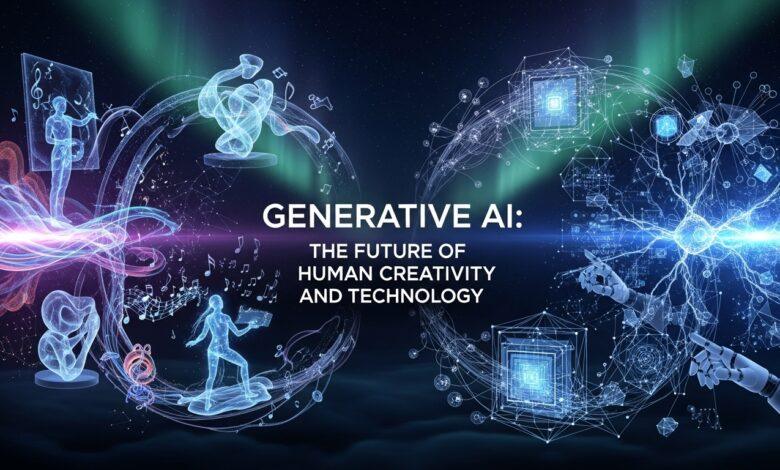
It’s strange to think that machines are starting to write, paint, and even compose songs. A few years ago, that sounded impossible. Today, it’s happening quietly on millions of screens around the world. This new wave of artificial intelligence called Generative AI is changing the meaning of creativity itself.
What Generative AI Actually Means
Generative AI is not about crunching numbers or following instructions. It’s about producing something new. These systems learn from enormous amounts of data — text, images, music — and then use that knowledge to create fresh content.
In simple terms, it’s the part of AI that tries to think creatively.
When you see an AI tool write a poem, design a logo, or generate an entire article, that’s generative AI at work.
The fascinating part is how it works. Instead of copying, it predicts. It looks at what you’ve asked for and then guesses, word by word or pixel by pixel, what should come next. That’s what makes its results feel almost human unpredictable yet logical.
How It’s Being Used Right Now
Generative AI isn’t limited to tech companies or developers anymore. It’s becoming a tool for everyone writers, designers, teachers, and even doctors.
 Also Read : Top AI Tools in Transforming the Future of Technology
1. Content and Marketing
Writers and marketers use AI tools like Jasper and Copy.ai to brainstorm ideas or speed up drafting The AI can write outlines, captions, or even long-form posts that sound surprisingly personal when edited by a human.
2. Art and Design
Artists use image models such as Midjourney or Adobe Firefly to explore new concepts. These tools can visualize thoughts that might take days to draw by hand. The final piece still needs a human touch, but AI accelerates the process.
3. Education
Teachers use generative AI to make quizzes or rewrite lessons for different AI learning levels.tool for Students rely on it for summaries and study notes. It’s not replacing teachers it’s helping them save time for what matters most: teaching.
4. Healthcare
In medicine, generative AI is helping researchers create possible drug formulas, simulate chemical reactions, and visualize the human body in new ways. It speeds up discoveries that once took years.
5. Software Development
Developers use AI assistants like GitHub Copilot to write pieces of code, fix errors, and explain logic in plain English. Instead of typing every line, programmers now collaborate with an AI partner.
How Generative AI Is Changing the Way Humans Create
When I first started exploring generative AI tools, I didn’t see them as something revolutionary. I thought they were just faster ways to write text or generate images. But over time, I realized something important generative AI doesn’t replace human creativity, it reshapes it.Instead of starting from a blank page, I now start with an idea and let AI help me explore different directions.
The creative process feels more fluid, more experimental, and less restricted by technical skills. Humans still decide what to create, while AI helps with how to bring that idea to life.
The Human Role in a Future Powered by Generative AI
There’s a common fear that generative AI will take creativity away from humans, but my experience says otherwise. The more advanced these tools become, the more human judgment matters.
AI can generate options, patterns, and variations, but it can’t understand context, emotion, or cultural nuance the way humans do. In the future, creativity won’t be about choosing between human or machine it’ll be about collaboration.
Those who learn how to guide AI, refine its output, and add personal perspective will have a clear advantage in both creative and technical fields.
Why Generative AI Feels So Different
Traditional AI follows clear instructions: if X happens, do Y.
Generative AI, on the other hand, starts with uncertainty. It doesn’t know the answer until it creates one. That makes it more human in a way curious, experimental, sometimes even wrong.
This creative unpredictability is exactly what makes it powerful for storytelling, art, and innovation. It’s not about perfection; it’s about possibilities.
Also Read : AI Voice Generator Pakistan 2025
The Benefits Are Hard to Ignore
Saves hours of repetitive work.
Sparks new ideas when humans feel stuck.
Makes creative industries more accessible.
Speeds up research, marketing, and design.
Bridges the gap between imagination and execution.
For small businesses, it’s a silent teammate. For creators, it’s a tool that never runs out of inspiration.
The Real Challenges
Still, it’s not flawless.
Generative AI raises big questions about originality and trust. Who owns an AI-generated image? How do we make sure AI doesn’t spread false or biased information?
And what about jobs that rely heavily on writing or design? The truth is, AI won’t replace creative people but creative people who use AI might replace those who don’t.
The key lies in balance: using AI to assist, not to take over.
Also Read : What is ChatGPT o1 Mini? How to Use ChatGPT o1 Mini
The Future Ahead
Generative AI is moving fast faster than most industries can keep up with. In the next few years, you’ll see it co-writing books, designing websites in real time, and maybe even producing movies with human guidance.
But even as machines learn to “create,” they still need direction. The ideas, emotions, and values that drive real art and communication are deeply human. That’s something no algorithm can copy completely.
So perhaps the real goal isn’t to compete with AI, but to collaborate with it to let technology amplify what humans already do best: imagine.




One Comment